Arts & Culture
Callisto Quartet shines at the Agassiz Chamber Music Festival
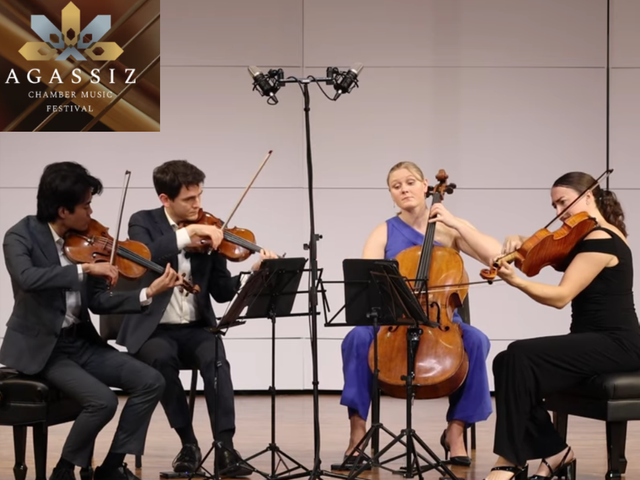
All week long, CMU’s Laudamus Auditorium has been filled with the sound of chamber music as the Agassiz Chamber Music Festival welcomed audiences to performances by some of the finest musicians working today. At the center of this year’s festival is the internationally acclaimed Callisto Quartet, an ensemble that has quickly become one of the most celebrated young string quartets in the world. .embed-container { position: relative; padding-bottom: 56.25%; height: 0; overflow: hidden; max-width: 100%; } .embed-container iframe, .embed-container object, .embed-container embed { position: absolute; top: 0; left: 0; width: 100%; height: 100%; } Formed in 2016 by four undergraduate students at the Cleveland Institute of Music, the quartet has earned top prizes at major competitions including the Fischoff National Chamber Music Competition and the Banff International String Quartet Competition, while also collecting honours in Bordeaux, Melbourne, and at Wigmore Hall. Since then, the ensemble has held residencies at major institutions including Rice University, Yale, and the Queen Elisabeth Music Chapel. Now appearing at the Agassiz Festival alongside the Agassiz Quartet, double bassist Meredith Johnson, harpsichordist Everett Hopfner, and pianist Steven Runge, the ensemble is presenting a diverse program featuring works by Mozart, Mendelssohn, Bach, Tchaikovsky, and contemporary Canadian composer Derek Charke. For violist Eva Kennedy, one of the quartet’s founding members, the ensemble’s rise has been the realization of a long-held dream. “I know that for both Hannah [Moses, cellist in the Callisto] and myself, we both had really wonderful chamber music experiences when we were young in like middle and high school,” Kennedy said. “And I know we both came to undergrad wanting to be in a professional quartet. So this is definitely what I always wanted to do.” Kennedy explained that while the group always envisioned a professional future together, maintaining a quartet over many years requires commitment and shared priorities. “One piece of advice that we received from a mentor a long time ago is that the best way to find success as a quartet is just to outlast everyone else,” she said. “Because it is so common for groups to have a really strong start and then just get pulled in different directions and kind of disintegrate.” Building a Quartet for the Long Term That commitment to longevity has become one of the defining features of the Callisto Quartet. Kennedy emphasized that all four members have remained focused on ensuring that the quartet continues to be a central part of their lives and careers. “I think that has been something we've been fortunate and something we've prioritized is just keeping, making sure all four of our goals are aligned and that we want to keep the quartet as a priority for a lifetime,” she said. Violinist Eric Tsai joined the quartet in 2024, fulfilling what he described as a lifelong ambition. For Tsai, the string quartet represents the highest form of musical collaboration. “So I think for me, the string quartet is the very highest form of chamber music making,” Tsai said. “And I might go so far to say music making in general.” Tsai spoke about the balance and intimacy that make the medium unique. “You have four people, which is just the right amount,” he said. “You have the voices, the middle voices, the low voices. And as opposed to something larger like a symphony orchestra where there's less flexibility, there's more of this kind of section feeling, everybody still feels very much like a soloist and we're really tugging and pulling against each other in a very intimate way.” He added that the quartet combines both individual artistry and collective power. “It’s also bigger than just two people or one person,” Tsai said. “So there is the power of all four voices combined into that, into the sound. And so I think there's something really, really magical about a string quartet.” Trust, Communication, and Musical Family Violinist Gregory Lewis joined the ensemble in 2022. Lewis explained that performing in the same ensemble every day creates a level of communication and trust that cannot easily be replicated in freelance chamber music settings. “There’s something that changes when it's the same three other people that you're playing with every single day,” Lewis said. “There's an element of trust. There's an element of openness and honestness that you can achieve as well.” Lewis noted that chamber musicians who work together only briefly often avoid being too direct in rehearsals out of politeness. A long-standing quartet, however, develops a different dynamic. “Whereas in a quartet when you're really worth the same people for years and years and years, you have built so much trust for each other and so much respect for each other that you can be really efficient in rehearsal,” he said. “You can be direct in a way that's not necessarily mean, but that accomplishes a lot very quickly.” Lewis compared the relationship within a quartet to that of a family. “It’s very much like a family dynamic where when you're communicating with your family at home, you can express things very openly and honestly because you have that trust that you're a family unit and you're always going to stick together and you all want the best for each other,” he said. “And so a quartet is kind of the musical iteration of that.” Kennedy added that one of the most rewarding aspects of quartet playing is the opportunity to revisit repertoire over many years rather than performing it only once. “We consider the first performance just the beginning of a long journey...we have just the greatest repertoire that there is.” Exploring Music Old and New In addition to standard repertoire by Mozart and Mendelssohn, the Callisto Quartet has built a strong reputation for championing contemporary works. During the festival, the ensemble performed music by American composer Reena Esmail as well as Derek Charke’s Sepia Fragments. Kennedy described the Charke work as especially meaningful to perform in Canada. “He is from Nova Scotia, and he really infuses kind of the maritime fiddling tradition into this piece,” she said. Commissioned for the St. Lawrence String Quartet’s twentieth anniversary, the piece moves rapidly between contrasting musical ideas while blending folk traditions with contemporary classical writing. “He says in his program notes that you can almost picture walking past a collage of sepia tone photographs,” Kennedy explained. “And so that's where the title Sepia Fragments comes from.” Kennedy described the work as energetic, fragmented, and highly varied. “There are lively dances. There's some really chaotic sections,” she said. “There are sections that quote classical composers whose work has been transformed into a totally new kind of energy.” The quartet is also performing Mozart’s famous Dissonance Quartet, a work known for its mysterious and harmonically adventurous opening. Tsai explained that the dramatic slow introduction serves as an emotional setup for the brighter music that follows. “It’s because of the darkness that came before,” he said. “So I think the dissonance, the opening section, definitely sets up the rest of the piece in a very beautiful way.” Returning to Winnipeg and Looking Ahead Another highlight of the festival is Mendelssohn’s Octet, performed in collaboration with the Agassiz Quartet. The monumental work remains one of the most beloved pieces in the chamber music repertoire. “It is such a pearl of a piece,” Lewis said. “It is perfect beginning to end.” Lewis also expressed amazement that Mendelssohn composed the work at such a young age. “It is so sophisticated and so well written,” he said. “And of course it's exuberant and it's joyful and it's high energy and just like it has every, it checks every box for what people want in a piece that is really fun to play.” Kennedy said she was especially excited by the variety of music featured throughout the concerts. “We have music as old as the Bach Brandenburg Concertos and music as new as this Sepia Fragments by Derek Charke,” she said. “We have small ensembles, large ensembles, different instruments being featured, and a whole stage full of really amazing musicians that we're really happy to play with.” Tsai is particularly looking forward to performing Tchaikovsky’s Souvenir de Florence, a work he has admired since childhood. “It’s a piece that I fell in love with when I was 12 or 13 and have always wanted to play,” he said. “This is my first time performing it.” For Lewis, the festival also represents a personal homecoming. Having spent much of his life in Winnipeg, returning to collaborate with local musicians has been deeply meaningful. “It really feels like a homecoming to get to play with so many of these people again and see them,” Lewis said. As the Agassiz Chamber Music Festival continues, the Callisto Quartet’s performances have demonstrated the remarkable chemistry and shared artistic vision that have propelled the ensemble onto the international stage. Through masterworks of the classical repertoire and adventurous contemporary music alike, the quartet continues to showcase the unique power of chamber music performed at the very highest level.